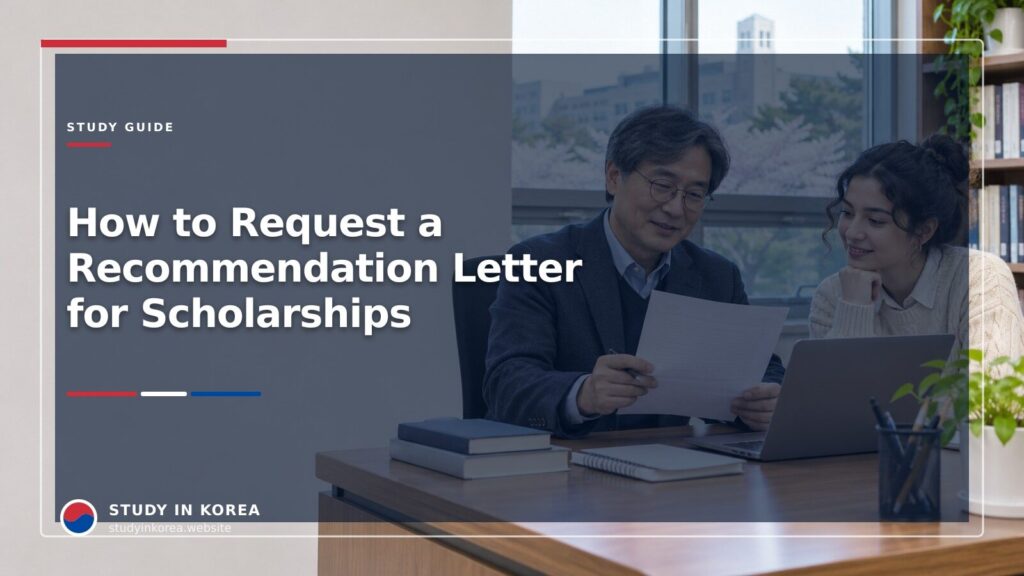
A recommendation letter gives an admissions or scholarship committee an independent view of your academic ability, character and potential. The strongest letter comes from a person who knows your work and can give specific examples. A famous title cannot replace direct knowledge.
Submission rules matter as much as the writing. Some Korean universities email a private link to the recommender. Others provide a form or require an official letterhead. Follow the current guide for each application.
In this article
- Choose the right recommender
- What to send with your request
- A clear recommendation letter structure
- Degree programs and different evidence
- Official submission rules in Korea
- Follow-up and common mistakes
- Help the recommender write credible evidence
- Recommendation request checklist
- Frequently asked questions
- Related Study in Korea guides
- Official sources and final checks
Choose the right recommender
Ask whether the person can write a positive and detailed letter. Give them an easy way to decline. Never write a letter yourself and present it as independent unless the application explicitly asks for a draft that the recommender will verify and submit.
- A teacher who assessed your recent academic work.
- A research supervisor who can explain your contribution.
- A department head or academic adviser who knows your progress.
- A work supervisor when professional experience is relevant and permitted.
What to send with your request
- The scholarship or degree name and official link.
- The deadline, time zone and submission method.
- Your current CV and academic transcript.
- A short summary of goals and relevant achievements.
- Draft points or projects the recommender personally observed.
- The exact name and title that should appear in the letter.
A clear recommendation letter structure
- State the recommender’s role and relationship with the applicant.
- Explain how long and in what setting they have known the applicant.
- Give two or three evidence-based examples of academic, research or leadership strengths.
- Connect those strengths to the program or scholarship.
- Close with a clear level of recommendation and verified contact details.
Degree programs and different evidence
The content should match the opportunity. A generic letter that only repeats grades adds little. A concise example of solving a problem, improving a project or supporting a team is more useful.
- Bachelor’s applicants can use classroom performance, curiosity and community contribution.
- Master’s applicants benefit from evidence of subject preparation and independent work.
- Doctoral applicants need examples of research judgment, persistence and technical ability.
- Exchange and short-term applicants can highlight adaptability and responsible participation.
Official submission rules in Korea
Seoul National University publishes designated recommendation forms for international admission. KAIST states that undergraduate recommenders submit electronically through the application platform. Requirements change by admission track. Do not assume email or a sealed envelope is accepted.
Enter the recommender’s email carefully. Ask them to check spam folders. Confirm submission status through the portal when the system provides that feature, but do not pressure the recommender for a copy of a confidential letter.
Follow-up and common mistakes
- Ask several weeks before the deadline.
- Send one polite reminder with the official deadline.
- Do not exaggerate achievements or invent a relationship.
- Do not reuse the wrong university or scholarship name.
- Thank the recommender and share the result when appropriate.
Help the recommender write credible evidence
A strong recommendation is easier to write when the referee receives a compact evidence pack. Include your current CV, transcript, draft statement, program link, scholarship criteria and deadline. Add a short note with two or three projects the referee personally observed. Do not write praise that the referee cannot verify.
Give context for each application. A research scholarship may value analytical ability and independence. A leadership award may need examples of initiative and service. The same letter should not be copied blindly when the selection criteria are different. The referee should decide what to include and submit the final version through the required channel.
Ask early and allow time for a refusal. A person who knows your work well is often more useful than a senior person who barely knows you. Send one polite reminder before the deadline. After submission, thank the referee and share the result when appropriate.
Recommendation request checklist
- Choose someone who can discuss recent, relevant work.
- Ask for consent before entering the referee’s contact details.
- Provide the official criteria and exact submission instructions.
- Explain the deadline and time zone clearly.
- Never upload or alter a confidential letter yourself.
Frequently asked questions
Who should write a scholarship recommendation letter?
Choose someone who knows your relevant academic, research, work or service record and can provide specific evidence.
How early should I request a recommendation?
Ask well before the official deadline. The exact submission schedule and method must be checked in the current application guide.
Can an applicant write the final recommendation letter?
The referee should control the final content and submission, especially when the letter is confidential. Follow the scholarship’s official rules.
Can the same letter be used for every scholarship?
A referee may reuse verified background, but the letter should address the criteria of the specific opportunity. No recommendation guarantees selection.
Related Study in Korea guides
Start with "Professional CV for scholarships", "Motivation letter guide", and "Emailing a professor professionally". Continue with "Study in Korea application steps" and "Korean university language requirements" for related planning.
Official sources and final checks
Rules can change between intakes. Confirm the latest details on these official pages before you apply or make a payment.
Share this content: