
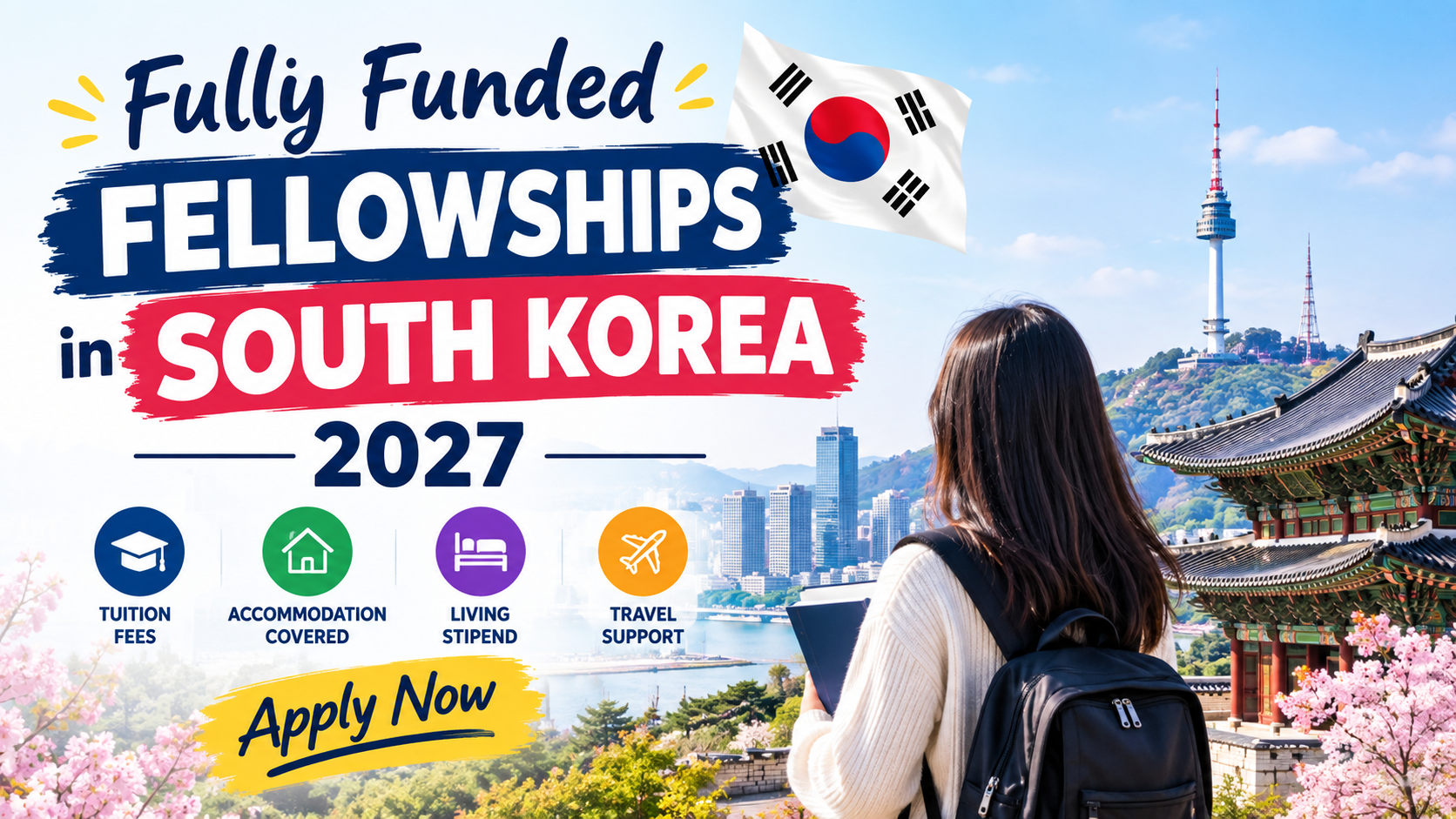
South Korea has quietly become one of the most attractive study destinations in Asia, and the number of students actively searching for Fully Funded Fellowships in South Korea 2027 proves it. Between cutting-edge research labs, generous government funding, and a genuine push to bring international talent into its universities, Korea is no longer a “backup option” for students who couldn’t get into the US or UK. It’s often the first choice.
If you’re a student, researcher, or young professional hoping to study, research, or train in Korea without paying a single won out of pocket, this guide walks you through everything: the major fellowship programs, who qualifies, how the application process actually works, what mistakes to avoid, and how to prepare for the interview stage that trips up so many strong candidates.
Why South Korea Has Become a Fellowship Hotspot
A decade ago, most international students heading to East Asia looked toward Japan or China first. That’s shifted. Korean universities like Seoul National University, KAIST, Yonsei University, and Korea University now sit comfortably in global rankings, and the government has backed that rise with real money.
A few reasons this matters for fellowship seekers:
- Korea’s government agencies fund thousands of seats every year through programs that cover tuition, housing, insurance, and a monthly stipend.
- English-taught programs have expanded rapidly, so Korean language fluency usually isn’t required at the application stage.
- The country’s economy runs on innovation (semiconductors, biotech, robotics, entertainment technology), so research funding tends to be well-resourced.
- Living costs outside Seoul’s premium districts remain manageable compared to Western capitals.
What “Fully Funded” Fellowship Offers
Before diving into specific programs, it helps to know what “fully funded” actually means in the Korean context, because not every scholarship labeled that way covers the same things. A genuinely fully funded fellowship typically includes:
- Full tuition waiver or reimbursement
- A monthly living stipend
- Round-trip or one-way airfare
- Health insurance during your stay
- A settlement allowance for your first weeks in the country
- In many cases, a year of Korean language training before your main program begins
If a program only waives tuition but leaves you to cover housing and living costs entirely on your own, it’s a partial scholarship, not a full fellowship. Read the fine print carefully.
The Major Fully Funded Fellowship Programs in Korea
1. Global Korea Scholarship (GKS)
This is the flagship program, run by Korea’s Ministry of Education through the National Institute for International Education (NIIED). Formerly known as the Korean Government Scholarship Program (KGSP), GKS funds undergraduate, master’s, PhD, and research-track students from almost every country in the world.
GKS runs through two separate routes, and picking the right one matters more than most applicants realize:
- Embassy Track: You apply through the Korean embassy or consulate in your home country. Competition is filtered nationally before candidates are forwarded to Korea.
- University Track: You apply directly to a partner Korean university, which then nominates a shortlist to NIIED.
Both tracks lead to the same scholarship benefits, but quotas, required documents, and internal deadlines differ, so check both options rather than assuming one is easier. You can find the official notice and detailed guidelines each cycle on the Study in Korea portal.
If you want a plain-language walkthrough of the embassy and university application steps, this guide on how to apply for the Korean Government Scholarship breaks the process down stage by stage.
2. KOICA Scholarship Program (CIAT)
Run by the Korea International Cooperation Agency (KOICA), this fellowship is aimed specifically at government officials and public-sector professionals from developing countries. It funds master’s and doctoral study in fields tied to national development such as public administration, agriculture, ICT, and public health.
Unlike GKS, KOICA scholarships are not open to fresh graduates with no work experience. Applicants generally need a track record in a government ministry, public agency, or related organization back home. In exchange, the program covers tuition, a monthly allowance, airfare, accommodation, and a completion grant, with the expectation that scholars return home to apply what they’ve learned.
3. Korea Foundation Fellowships
The Korea Foundation supports researchers and graduate students working on Korean studies, language, and cultural or policy research. It’s a smaller, more specialized pool than GKS, but the funding is generous and the application pool tends to be less crowded because fewer students know it exists.
4. University-Specific Fellowships
Beyond government programs, individual universities run their own fully or partially funded fellowships for international applicants, often layered on top of, or as an alternative to, GKS. Some of the strongest options worth comparing side by side are listed in this roundup of top Korean universities offering scholarships to international students, including institutions like Hallym University, Chung-Ang University, HUFS, and UNIST that regularly reserve seats and tuition waivers for foreign applicants.
For students specifically drawn to STEM and research, UNIST’s scholarship track is worth a close look, since it pairs tuition waivers with lab-based research opportunities from the first semester.
Who Is Eligible
Eligibility varies slightly by program, but most fully funded fellowships in South Korea share a common baseline:
- You must not hold Korean citizenship (dual citizens are usually excluded too)
- You need a completed degree at the level below the one you’re applying for (high school diploma for undergraduate, bachelor’s for master’s, and so on)
- A minimum GPA, usually around 80% or a 2.64/4.0 equivalent, though this varies by program
- Good health, confirmed through a medical exam later in the process
- Some programs cap applicant age (commonly under 40 for graduate-level fellowships)
- English proficiency (IELTS, TOEFL, or equivalent) if you’re applying to an English-taught track, or TOPIK scores if applying in Korean
Always confirm exact GPA cutoffs and age limits against the current official notice, since these details are adjusted slightly from one intake to the next.
Required Documents
Paperwork is where a lot of strong applicants stumble, not because they lack the qualifications, but because they submit incomplete or inconsistent files. A typical application folder includes:
- Completed application form (often submitted in both English and Korean)
- Academic transcripts and degree certificates, officially translated and notarized
- A personal statement outlining your academic and career goals
- A study or research plan specific to your intended field
- Two letters of recommendation from professors or employers
- A copy of your passport
- A medical examination report
- Proof of English or Korean language proficiency, if required
Double-check whether documents need apostille certification or notarization from your country’s foreign affairs ministry. This step alone causes more rejections than weak grades do.
How to Apply: Step by Step
- Shortlist programs early. Don’t wait until the announcement drops to figure out which track fits you. Compare GKS, KOICA, Korea Foundation, and university-run options months in advance.
- Contact your target department or professor. For research and PhD tracks especially, reaching out to a potential supervisor before applying can genuinely improve your odds and helps you write a sharper research plan.
- Prepare documents in parallel, not sequentially. Transcripts, translations, and recommendation letters take weeks to arrive. Start requesting them the moment you decide to apply.
- Submit through the correct track. Embassy and university tracks have separate portals, forms, and sometimes separate deadlines. Submitting to the wrong one, or missing one because you assumed the other covered it, is a common and avoidable error.
- Track your application status. Most programs list a multi-stage timeline (document screening, first-round interviews, final selection). Keep copies of every confirmation email.
- Prepare for interviews. Shortlisted candidates for GKS, KOICA, and most university fellowships go through at least one interview round, usually online.
Interview Tips That Actually Help
Interviews for Korean fellowships tend to be conversational rather than adversarial, but panels are looking for specific signals:
- Know your “why Korea” answer cold. Vague answers about K-dramas or K-pop rarely land well. Talk about specific labs, professors, curricula, or industries that pulled you toward Korea.
- Be ready to defend your study or research plan. Panels often probe whether you’ve actually thought through your timeline, not just written an impressive-sounding proposal.
- Show you understand the return-on-investment angle. Many Korean fellowships, KOICA especially, are funded with an expectation that scholars bring skills back home. Speak to that.
- Keep answers concise. Interview slots are short. Practice trimming your answers to two or three focused sentences before adding detail.
- Test your tech setup beforehand if the interview is online. Connection drops during a ten-minute slot can cost you more than a weak answer would.
Common Mistakes to Avoid
- Applying to only one track. Candidates who apply through both embassy and university tracks (where allowed) generally have better odds than those who commit to just one.
- Generic personal statements. Recycling the same essay across five different countries’ scholarships is easy to spot, and reviewers do spot it.
- Ignoring the fine print on funding duration. Some fellowships fund the full degree; others fund a capped number of years and expect you to cover any overrun yourself.
- Missing internal university deadlines. University track deadlines are often earlier than embassy track deadlines. Students frequently miss this and assume they have more time than they do.
- Skipping the medical exam requirements. Some countries require exams to be conducted at government-approved clinics only. Confirm this before your appointment, not after.
Life in Korea
Once you’ve secured funding, the next adjustment is logistical and cultural:
- Housing: Most fellowships place first-year students in dormitories, which is worth taking even if it’s not glamorous, since it simplifies your first months enormously.
- Banking: You’ll need an Alien Registration Card (ARC) before you can open a Korean bank account, so plan your first two weeks around getting that processed quickly.
- Weather: Winters in Seoul and much of the country get genuinely cold, well below freezing for weeks at a stretch, so budget for proper winter clothing in your settlement allowance spending.
- Transport: Korea’s subway and bus network is efficient and inexpensive; a T-money card will get you around almost any city without needing a car.
- Language basics: Even in English-taught programs, learning basic conversational Korean early makes daily errands, doctor visits, and casual friendships far easier.
Frequently Asked Questions
1. What is the most competitive fully funded fellowship in South Korea? The Global Korea Scholarship is generally considered the most competitive simply because of application volume, though its large number of available seats also makes it one of the more accessible options relative to how prestigious it is.
2. Do I need to know Korean to apply for these fellowships? No, most programs, including GKS and many university tracks, offer English-taught options and don’t require Korean proficiency at the application stage, though some programs include mandatory Korean language training once you arrive.
3. Can I apply for more than one fellowship at the same time? Yes, in most cases you can apply to GKS, KOICA (if you meet its professional eligibility), and individual university scholarships simultaneously, as long as you can meet each program’s separate document and deadline requirements.
4. Are fully funded fellowships in South Korea open to all nationalities? Nearly all major programs are open globally, though a handful of specific university or agency-run fellowships are restricted to partner countries. Always check the eligible countries list in the specific year’s official notice.
5. How early should I start preparing my application? Ideally six to eight months before the deadline, mainly because document translation, notarization, and recommendation letters take longer than most applicants expect.
6. Does a fully funded fellowship cover my family if I bring them to Korea? Generally no. Most fellowships are designed to support a single scholar, and dependents’ visas, housing, and living costs are usually the scholar’s own responsibility.
7. What happens if I fail a course or don’t meet academic standards during the fellowship? Most programs include a probation or warning system before funding is withdrawn, but consistently low grades or failing to meet Korean language benchmarks (where required) can result in the scholarship being discontinued.
The number of fully funded fellowships in South Korea has genuinely expanded over the past several years, and the country’s universities are actively competing to bring in strong international candidates rather than simply tolerating them. That shift works in your favor if you approach the process seriously: pick the right track, prepare your documents early, write a study plan that sounds like you actually mean it, and treat the interview as a real conversation rather than a script to recite.
Korea’s mix of funding generosity, academic quality, and cultural energy makes it one of the smarter bets in international education right now, and for students willing to put in the preparation, a fully funded seat is a realistic goal rather than a long shot.
Share this content:

