
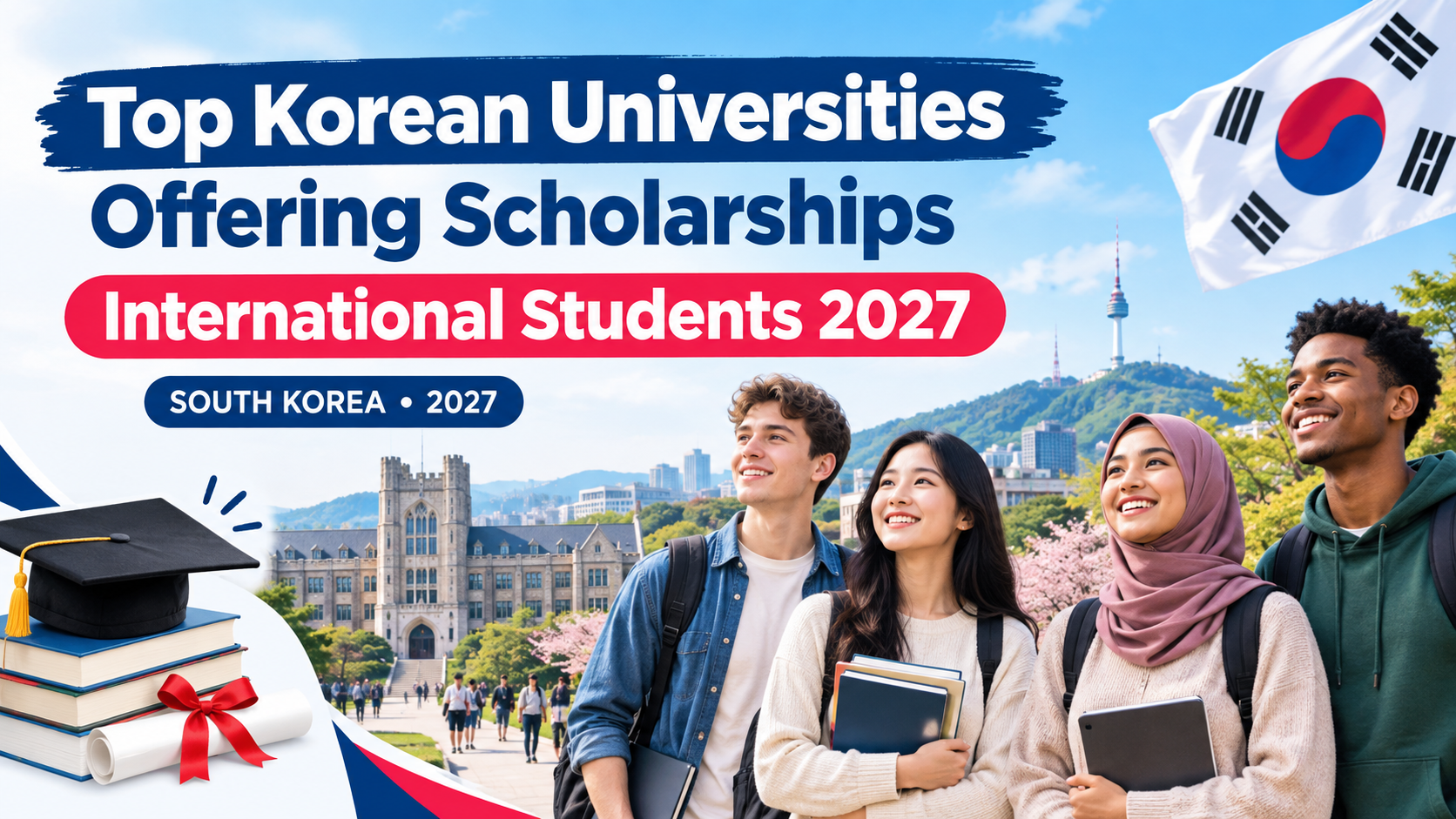
South Korea has quietly become one of the smartest places on the planet to chase a world-class degree without draining your savings. If you are mapping out where to apply for the 2027 intake, this guide walks you through the Top Korean Universities Offering Scholarships for International Students 2027, what each award actually covers, and how to put together an application that stands out from thousands of others chasing the same seats.
Korea is not offering these scholarships out of generosity alone. The country’s population is aging, its classrooms have empty seats, and its economy needs skilled graduates who understand both Korean culture and global markets. That combination has turned into real opportunity for outsiders willing to make the move, and the government’s own Study Korea 300K Project has widened scholarship access, relaxed visa requirements, and extended post-graduation work windows to attract exactly this kind of student.
Why International Students Are Choosing Korea Right Now
Seoul was ranked the world’s number one student city in the QS Best Student Cities index, edging out Tokyo and dethroning London after six straight years at the top. That ranking is not a fluke. It measures things students actually feel day to day, things like affordability, safety, employer demand for graduates, and how welcoming a city is to newcomers, and Seoul scored strongly across nearly every one of them.
Add to that a fast, reliable subway system, some of the world’s quickest internet, a booming tech and entertainment industry that is actively hiring foreign talent, and a genuine cultural curiosity that Korean pop culture has exported worldwide, and it is easy to see why the country now hosts well over 300,000 international students.
Types of Scholarships Available in Korea
Before diving into individual schools, it helps to understand how funding is structured here. Scholarships in Korea generally fall into three buckets:
- Government-funded awards, led by the Global Korea Scholarship, financed by the Ministry of Education and administered through the National Institute for International Education (NIIED). These are the most generous and, unsurprisingly, the most competitive.
- University-run scholarships, granted directly by individual schools, often automatically when you submit your admission file, based on your grades, test scores, or Korean language ability.
- Institute and foundation-backed awards, such as scholarships tied to corporate foundations, which behave like full university scholarships but come with their own separate conditions and selection panels.
Knowing which bucket a scholarship falls into changes how you should apply. Government scholarships usually need a separate application through an embassy or a partner university, while most school-based awards are folded straight into your regular admission form, no extra paperwork required.
Global Korea Scholarship (GKS): The Flagship Award
If there is one scholarship worth building your entire application timeline around, it is the Global Korea Scholarship (GKS), formerly known as KGSP. Funded by the Ministry of Education and run through NIIED, GKS is Korea’s flagship program for international students and, frankly, one of the most complete scholarship packages offered by any government anywhere.
A typical GKS award includes:
- Full tuition coverage, with your university waiving whatever the government stipend does not cover
- A monthly living allowance, generous enough to cover rent, food, and daily expenses without a part-time job
- A full year of Korean language training before your degree officially begins
- One round-trip economy flight ticket to and from Korea
- Medical insurance and a settlement allowance for your first weeks in the country
Selection runs through two tracks, one through Korean embassies in your home country and another through partner universities directly, so check both routes rather than assuming only one applies to you. Applications for the 2027 cycle typically open around September of the preceding year, so start preparing your documents well ahead of that window.
Seoul National University (SNU)
Ranked as South Korea’s top university and among the world’s best in the latest QS rankings, Seoul National University mainly channels international undergraduates toward GKS itself, alongside the Overseas Koreans Scholarship for students of Korean descent living abroad. If GKS does not come through, SNU still opens additional scholarship rounds after enrollment, so grades earned in your first year at SNU genuinely matter for future funding.
Yonsei University
One of the famed “SKY” universities, Yonsei University runs its Underwood International College entirely in English, and its Admissions Scholarship can cover full tuition for all four years of your undergraduate degree. Every applicant is automatically considered, no separate scholarship essay needed, though you will need to maintain a strong GPA each semester to keep it. Students who miss the top award still get a shot at need-based and merit funding offered each term.
Korea University
The third member of the SKY trio, Korea University bundles its scholarship decision directly into the admission review, meaning there is no extra form to fill out. Once you are enrolled, competition for further awards resumes each semester based on academic performance, so download the current admission guide from the Office of International Affairs before applying, since the terms shift slightly year to year.
KAIST (Korea Advanced Institute of Science and Technology)
Based in Daejeon and consistently ranked among Asia’s leading science and engineering schools, KAIST folds its scholarship straight into the admission application. It covers full tuition for eight semesters, a monthly stipend, and health insurance, and the GPA requirement to retain it after your first year is comparatively forgiving. For students chasing a STEM degree taught entirely in English, KAIST is hard to overlook.
POSTECH (Pohang University of Science and Technology)
Every student admitted through POSTECH’s international track receives a full tuition scholarship automatically, provided they keep passing the required course load and grades across all eight semesters. On top of tuition, international students can also access a settlement grant, living allowance, campus work-study positions, and a dedicated Korean language scholarship.
Sungkyunkwan University (SKKU)
Backed by the Samsung Foundation since 1996, SKKU runs one of the widest scholarship menus in the country, including admission scholarships, awards for strong Korean or English language ability, merit-based funding, and the notable Samsung Global Sungkyun Scholarship reserved for international students. Few schools in Korea give applicants this many funding paths to choose from.
UNIST (Ulsan National Institute of Science and Technology)
UNIST hands every international undergraduate a full tuition waiver in their very first semester. From there, your GPA decides how much continues, a modest average keeps a partial waiver, while a stronger one restores full coverage. Olympiad medalists get an extra monthly stipend on top, and every new international arrival receives a one-time settlement grant. If you want a closer look at how the tiers work, our breakdown of UNIST Scholarships goes through the full eligibility ladder.
Hanyang University
Hanyang University’s International Excellence Awards trim tuition by 30, 50, or even 70 percent for a semester at a time, decided through submitted documents and an interview held each March and September. You will need a TOPIK certificate and a solid GPA to qualify, and students already holding GKS or another outside award are not eligible, making this scholarship best suited to self-funded students trying to lower their costs term by term.
Kyung Hee University
With campuses in both Seoul and Yongin, Kyung Hee University attaches most of its scholarships directly to your admission offer. Top students in each college receive full first-semester tuition, strong TOPIK scores unlock full or half waivers, and its SDGs Scholarship supports students from lower-income countries, and those holding refugee status in Korea, with tuition coverage lasting up to four years.
Sogang University
Sogang University awards admission scholarships based on your entrance results and language proficiency, with coverage ranging from a quarter up to full tuition depending on the year’s guidelines. Its Graduate School of International Studies runs a separate, widely known scholarship track covering between 25 and 100 percent of tuition for postgraduate applicants.
Konkuk University
Konkuk University works well as a GKS partner school, layering extra perks on top of the government package, including a guaranteed dorm room, monthly housing support, a personal student mentor, and cultural orientation programs. Students outside GKS can still apply for tuition reductions tied to grades and TOPIK level.
GIST (Gwangju Institute of Science and Technology)
A government-backed science institute much like KAIST and POSTECH, GIST offers a genuinely full-ride scholarship to admitted international undergraduates, reflecting how deeply financial support is baked into its admissions model rather than treated as a bonus.
Two More Schools Worth Checking
Beyond the household names, a handful of mid-size universities run scholarship programs that quietly rival the bigger institutions. Hallym University’s scholarship program is worth a look for students who want a smaller campus with strong tuition support, and Chung-Ang University’s scholarships are popular among students targeting media, business, and arts programs in central Seoul.
Tips to Strengthen Your Scholarship Application
Getting shortlisted for a Korean scholarship rarely comes down to grades alone. A few habits separate the applicants who get funded from those who get waitlisted:
- Start your Korean language study early, even a basic TOPIK level 2 or 3 shows commitment and opens more scholarship tiers than English proficiency alone.
- Tailor your statement of purpose to the specific university’s strengths rather than reusing one generic essay across every application.
- Request recommendation letters months in advance, professors get flooded with these requests right before deadlines and rushed letters tend to read that way.
- Track deadlines separately for embassy and university GKS tracks, missing one because you assumed the other applied to you is a common and avoidable mistake.
- Keep digital copies of every transcript, certificate, and passport page ready to upload, since document requirements can appear with short notice.
Common Mistakes Applicants Should Avoid
Even strong candidates lose scholarship offers over avoidable errors. Watch out for these:
- Submitting an application with mismatched personal details across documents, which triggers automatic rejection at many universities.
- Ignoring the GPA maintenance requirement after year one, since several scholarships listed above are conditional, not guaranteed for the full degree.
- Applying to only one funding track when both embassy and university routes are open to you.
- Waiting until the deadline week to request official transcripts, which some institutions take weeks to issue.
- Underestimating the interview stage, some scholarships shortlist far more candidates than they fund, and the interview is where final decisions are made.
Interview Tips for Scholarship Panels
If your application reaches the interview stage, treat it as seriously as the paperwork. Panels typically want to hear why Korea specifically, not just why studying abroad in general, so have a genuine, specific answer ready. Practice explaining your academic plans in plain, confident language rather than memorized phrases, since interviewers can usually tell the difference. It also helps to research the university’s specific research strengths or industry partnerships beforehand, referencing them naturally shows you did more than skim the admissions page.
Travel and Arrival Tips
Once your scholarship is confirmed, the practical side of the move begins. Book your flight only after your visa (D-2 for degree students, D-4 for the language year) is issued, since airlines can deny boarding without one. Most universities assist with airport pickup for scholarship recipients, so confirm this with your international office rather than assuming it is automatic. Pack layered clothing regardless of season, Korea’s weather swings hard between humid summers and freezing winters, and bring a small supply of any prescription medication, since not every brand is available locally. Finally, register for a Korean bank account and a local SIM card within your first week, both are needed for almost everything from campus registration to grocery delivery apps.
Frequently Asked Questions
1. Which scholarship covers the most for international students in Korea? The Global Korea Scholarship remains the most complete package, covering tuition, a living allowance, flights, and a full year of language training, though it is also the most competitive to win.
2. Do I need to speak Korean to qualify for these scholarships? Not always. Many programs, including those at KAIST, Yonsei’s Underwood International College, and POSTECH, are taught entirely in English, though a TOPIK certificate can unlock additional scholarship tiers at several universities.
3. Can I apply for both a government scholarship and a university scholarship at the same time? Generally no. If you are awarded GKS, universities typically exclude you from applying to their separate internal scholarships, since GKS already covers your full costs.
4. When should I start preparing for the 2027 intake? Begin gathering transcripts, language certificates, and recommendation letters at least a year in advance, since GKS applications usually open around September of the preceding year and university deadlines vary widely.
5. Are these scholarships only for undergraduate students? No. While GKS and several university awards focus on undergraduates, most of the schools listed also run separate graduate and PhD scholarship tracks with their own eligibility rules.
6. What happens if I lose my scholarship due to low grades? Most university scholarships are conditional on maintaining a minimum GPA each semester. Falling below it usually reduces your award tier rather than cancelling it outright, though repeated low grades can end funding entirely, so check each school’s specific policy.
7. Is it possible to work part-time while on a scholarship in Korea? Yes, with permission. Scholarship recipients on a student visa can apply for part-time work authorization after meeting language or academic conditions set by immigration and their university’s international office.
Choosing between these programs really comes down to what you want out of your degree: the safety net of a fully funded government award, or the flexibility of applying directly to a university whose scholarship folds straight into your admission offer. Either way, the earlier you start organizing your documents and language preparation, the stronger your position will be once the 2027 application windows open.
Share this content:

