

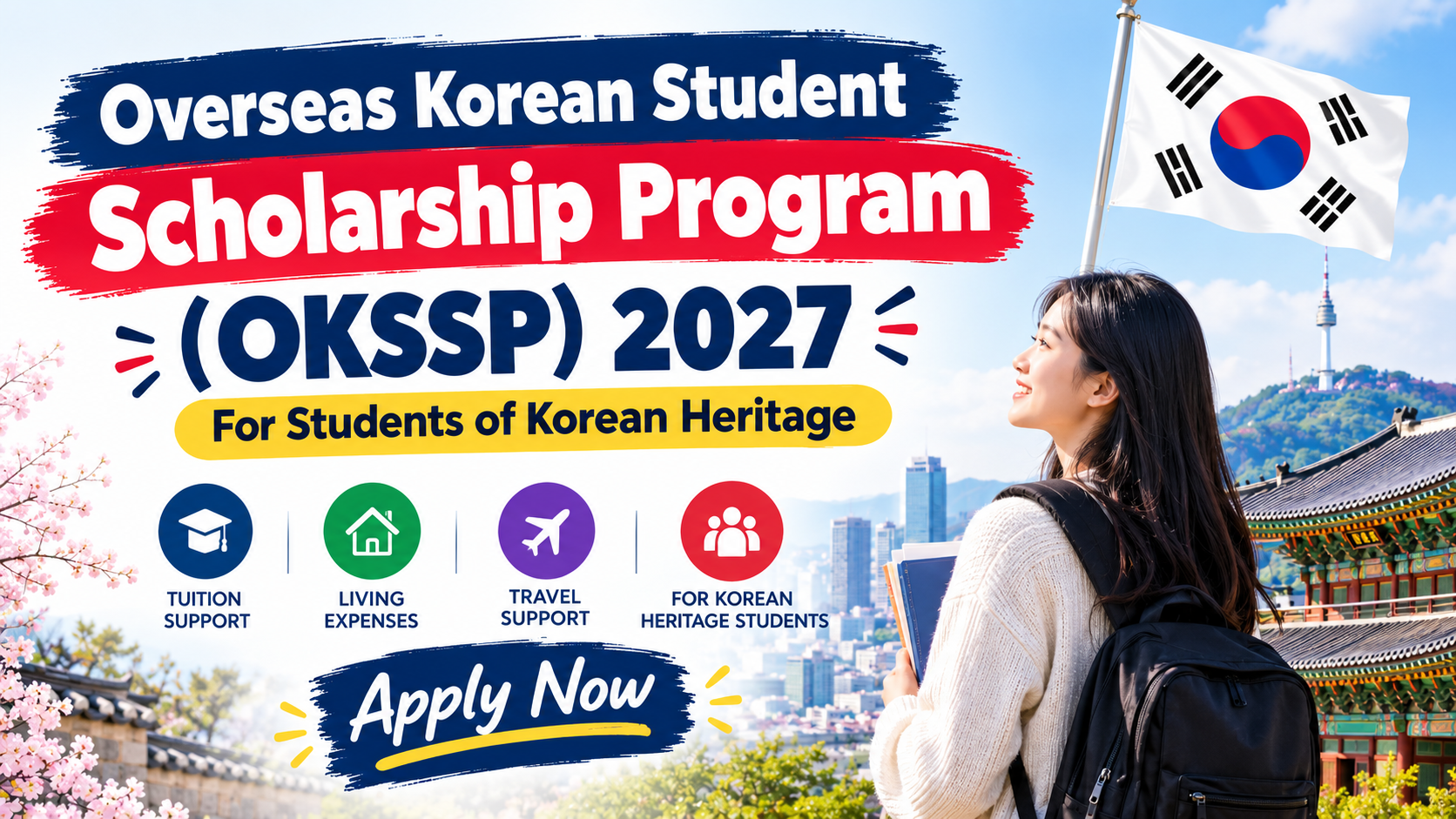
If you are a young person of Korean descent living outside South Korea and you have ever wondered how to turn your family roots into a real academic opportunity, the Overseas Korean Student Scholarship Program (OKSSP) 2027 is worth a close look. Run by the Korean government through its overseas diplomatic missions, this scholarship is built specifically for the global Korean diaspora, students whose parents or grandparents left the peninsula but who still carry that heritage with them. It is not just a financial award. It is an invitation to reconnect with a culture, a language, and a country that many applicants have only known through family stories.
This guide walks you through everything you need to understand about the program: who can apply, what it actually pays for, how the selection process works, and the small details that often make the difference between a strong application and a rejected one.
What Is the Overseas Korean Student Scholarship Program?
The OKSSP is a scholarship initiative created to support overseas Korean students who wish to pursue their Bachelor’s, Master’s, or Ph.D. degrees at universities inside South Korea. Unlike some scholarships that focus purely on academic merit, this one has a dual mission: to nurture future leaders within Korean communities abroad, and to strengthen the bridge between the diaspora and their ancestral homeland.
Each year, dozens of students are selected, often around 80 recipients across all degree levels, and given both financial support and a structured path into Korean academic and cultural life. Beyond tuition and a living stipend, selected students get access to mentoring, cultural exchange events, and networking opportunities with other overseas Koreans through initiatives like OKFriends.
You can find official program updates and application announcements through Korean embassies and consulates worldwide, as well as on the government’s central portal at Study in Korea, which is operated directly by the Korean government and lists scholarship guidelines for international and heritage applicants alike.
Why This Scholarship Matters for the Korean Diaspora
For many second or third generation Korean students abroad, Korean identity can feel like something inherited rather than lived. The OKSSP tries to close that gap. It is designed for:
- Students who grew up speaking little or no Korean but want to reconnect with their heritage
- Descendants of Korean adoptees who want to explore their birth culture
- Children of multicultural families, particularly across Southeast Asia
- Academically strong students who may not have the financial means to study abroad on their own
The program essentially treats heritage as a bridge, not a requirement for fluency or prior cultural exposure. That is part of what makes it different from general international scholarships like the Global Korea Scholarship, which is open to all foreign nationals regardless of ancestry.
Eligibility Requirements
While exact wording is updated annually by the National Institute for International Education (NIIED) and the Ministry of Foreign Affairs, the core eligibility criteria have remained fairly consistent:
- You must be an overseas Korean, meaning you hold permanent residency or citizenship of another country, or you hold Korean nationality but were raised and educated abroad
- You must have completed your prior education (high school, undergraduate degree, etc., depending on the level you are applying for) outside of Korea
- You should be planning to begin study at a Korean university in the upcoming Spring or Fall semester
- Students who are already enrolled at a Korean university as of the relevant admission cycle may still be eligible in some cases
Priority consideration is typically given to:
- Descendants of notable overseas Koreans, or families who contributed meaningfully to Korean communities abroad
- Financially disadvantaged applicants who can demonstrate need
- Students majoring in Science, Engineering, or Korean Studies
- Korean adoptees, or children of Korean adoptees
- Applicants from multicultural families in Southeast Asia
- Fluent Korean speakers, often verified through TOPIK test results
It is worth noting that Korean language ability is helpful but not always mandatory at the application stage, since the scholarship’s purpose includes helping students who are disconnected from the language reconnect with it.
What the Scholarship Covers
The OKSSP is a substantial benefits package rather than a token award. Selected students generally receive:
- Tuition support for their chosen degree program
- A monthly living stipend to cover housing and daily expenses
- Korean language training, often through a preparatory course before the degree program begins
- Mentoring and cultural programming, including exchange activities with overseas Korean communities both in Korea and abroad
- Access to OKFriends and regional networking events, which connect scholars with alumni and current students from similar backgrounds
This combination means recipients are not just funded academically, they are supported socially and culturally as they adjust to life in Korea, which can be a real challenge even for students who grew up hearing Korean at home.
Application Timeline and Process
Applications are usually coordinated through the Korean embassy or consulate in your country of residence, not directly through individual universities. The general flow looks like this:
- Announcement: The embassy or consulate publishes the call for applications, usually months before the semester starts
- Document submission: Applicants prepare academic transcripts, recommendation letters, a personal statement, and proof of Korean heritage
- Local review: The public office (embassy or consulate) reviews submitted applications
- Interview stage: Shortlisted candidates are usually interviewed, either in person or virtually
- Final selection and notification: Results are announced, followed by visa and enrollment procedures
Deadlines vary by country and by mission, so it is essential to check with your local Korean embassy directly rather than relying solely on third-party summaries. The Ministry of Foreign Affairs overseas missions portal is the most reliable place to find your country-specific consulate page and exact submission dates.
Tips to Strengthen Your Application
A scholarship this competitive rewards preparation. A few practical tips that genuinely make a difference:
- Start your documents early. Transcripts, translations, and notarizations often take weeks, not days.
- Be specific in your personal statement. Vague statements about “loving Korean culture” are common; reviewers respond better to concrete stories about your family history, your goals, and how a Korean education fits your future plans.
- Highlight your heritage connection clearly, especially if you qualify under a priority category like being a descendant of a notable overseas Korean or coming from a multicultural family.
- Don’t underestimate the interview. Reviewers are not just checking your Korean language skill; they want to see genuine motivation and clarity about your academic direction.
- Get recommendation letters from people who know you well, not just titles that sound impressive. A detailed letter from a teacher who understands your work ethic carries more weight than a generic one from a well-known figure.
Common Mistakes Applicants Should Avoid
Many strong candidates lose points for avoidable reasons. Watch out for these:
- Submitting incomplete documentation. Missing a single required form can disqualify an otherwise excellent application.
- Ignoring the specific priority criteria. If you qualify for financial need or heritage-based priority, say so directly and provide the supporting proof, don’t assume reviewers will infer it.
- Ignoring embassy-specific deadlines. Deadlines differ by country, and applications submitted directly to Korea instead of through the correct local mission are often rejected outright.
- Writing a generic personal statement. Reusing an essay written for a different scholarship rarely reads well; reviewers can usually tell.
- Underestimating language preparation. Even if Korean fluency isn’t mandatory, showing that you’ve made an effort to study the language strengthens your case considerably.
Interview Preparation Tips
If you’re shortlisted, the interview stage is where many candidates either seal the deal or lose momentum. A few things to keep in mind:
- Be ready to explain why Korea specifically, not just “because of my heritage.” Reviewers want to see a real academic or career reason.
- Practice answering questions about your family’s connection to Korea in a way that feels natural, not memorized.
- Research your intended major and be able to discuss why that field, and why a Korean university is the right place to study it.
- If your Korean is limited, it’s fine to answer in English or your local language, but showing willingness to learn (perhaps mentioning any TOPIK study or language classes) leaves a strong impression.
Life in Korea: What New Scholars Should Know
Adjusting to Korea involves more than academics. A few practical notes for incoming students:
- Housing: Most universities offer dormitory options for scholarship recipients in the first year, which is usually the easiest route while you settle in.
- Cost of living: Seoul is more expensive than smaller cities like Daejeon or Gwangju, so factor this into your budgeting even with a stipend.
- Healthcare: International and overseas Korean students are generally required to enroll in Korea’s National Health Insurance system, which is affordable and covers most basic medical needs.
- Cultural adjustment: Even students with Korean family backgrounds often experience some culture shock, since growing up abroad and living in Korea day to day are very different experiences. Giving yourself time to adjust, rather than expecting instant familiarity, helps a lot.
Alternative and Related Scholarship Options
If you are researching the OKSSP, it is worth also exploring other funding routes in case you don’t fit every criterion, or simply to widen your options. For heritage-related and general opportunities, applicants often compare pathways such as the Korean Government Scholarship application process, which lays out a broader view of government-funded study routes, and university-specific offers such as HUFS scholarships for international students, which can be a good fit for students interested in language and international studies programs. It’s also worth comparing options across institutions, since some schools run their own generous packages, as seen with the UNIST scholarships for students leaning toward science and technology fields.
Looking at multiple programs side by side often gives applicants a clearer sense of which scholarship truly matches their background, major, and financial situation.
Frequently Asked Questions (FAQs)
1. Who exactly qualifies as an “overseas Korean” for this scholarship? Generally, this includes people holding permanent residency or citizenship in another country who have Korean heritage, as well as Korean nationals who were raised and educated abroad. Exact documentation requirements are confirmed by your local embassy.
2. Do I need to speak Korean fluently to apply? No, fluency is not always mandatory. Many applicants join with limited Korean and receive language training as part of the program. That said, demonstrated effort to learn Korean, such as TOPIK scores, can strengthen your application.
3. Can I apply if I am already studying at a Korean university? In some cycles, students who are already admitted to and attending a Korean university by a specific date may still be eligible. This detail changes slightly year to year, so confirm current rules with your embassy.
4. How many students are selected each year? The number varies, but historically the program has selected around 80 students annually across Bachelor’s, Master’s, and Ph.D. levels combined.
5. Where do I submit my application? Applications go through the Korean embassy or consulate in your country of residence, not directly to universities or a central Korean government office.
6. Does the scholarship cover living expenses, or just tuition? It typically covers both. Recipients usually receive tuition support along with a monthly stipend, plus access to language training and mentoring programs.
7. What happens if I miss my country’s application deadline? Unfortunately, late applications are generally not accepted, since each embassy works on a fixed review timeline. It’s best to set your own internal deadline a few weeks earlier to leave room for document corrections.
Final Thoughts
The Overseas Korean Student Scholarship Program offers something genuinely rare: a fully supported academic path back to a heritage that many students have only known secondhand. It rewards not just grades, but genuine motivation, family history, and a willingness to grow into a role that connects overseas Korean communities with the country their families once called home. If you meet the eligibility criteria, the best next step is simple: reach out to your local Korean embassy or consulate, confirm the current year’s exact requirements, and start preparing your documents early. A well-prepared application, submitted on time, is often the biggest deciding factor between students who get selected and those who don’t.
For further scholarship opportunities and university-specific funding options in Korea, browsing through resources like the list of top Korean universities offering scholarships can help you build a backup plan alongside your OKSSP application.
Share this content:

. Learn eligibility, benefits, deadlines, and how to apply!)