
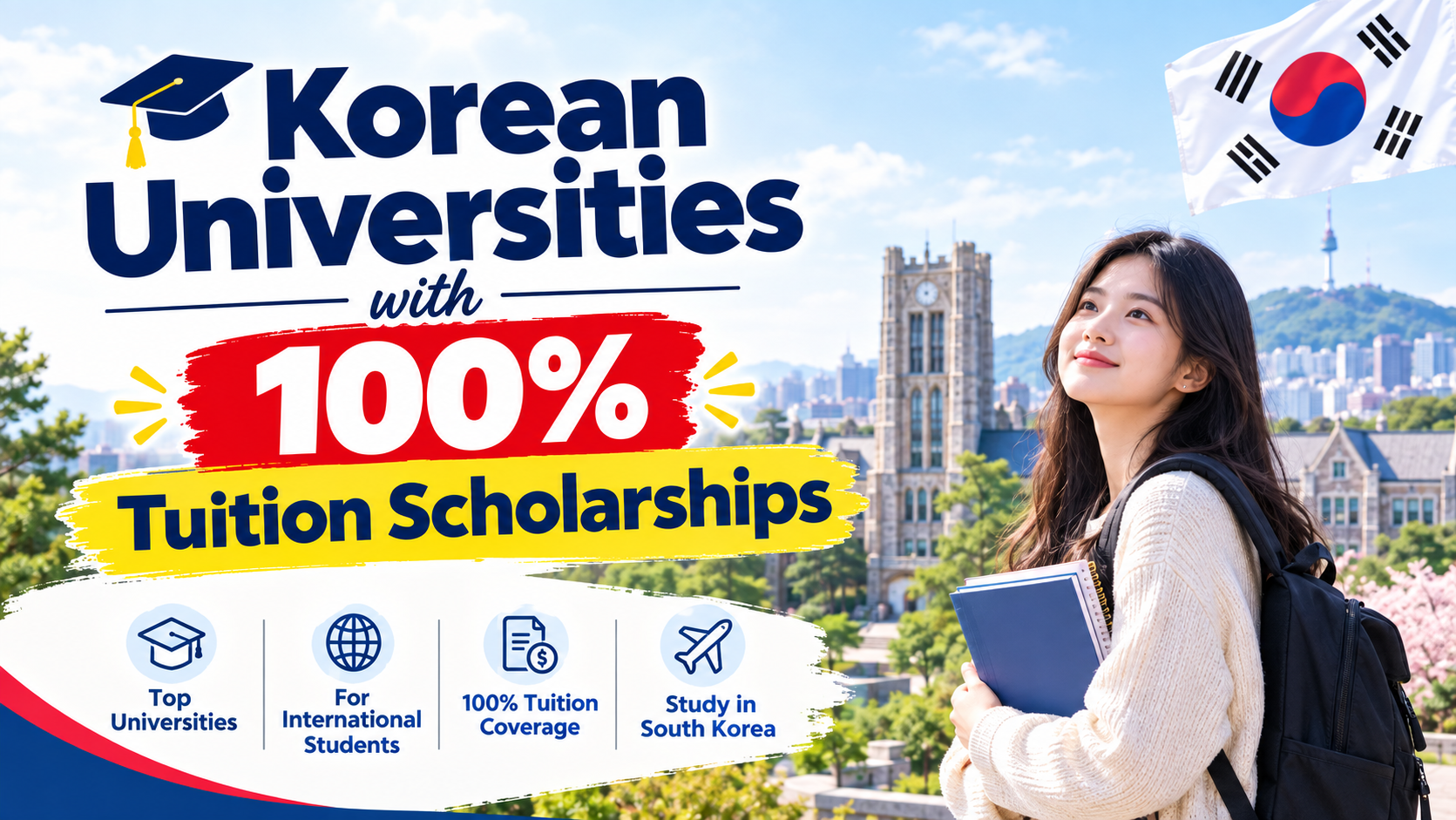
South Korea has quietly become one of the most attractive study destinations for students who want a world-class education without draining their savings. In 2026, thousands of international applicants are once again searching for Korean universities with 100% tuition scholarships for international students, and honestly, it’s not hard to see why. Between cutting-edge research labs, a booming tech economy, and a culture that blends tradition with innovation, Korea offers something most countries simply can’t match on the funding side: genuine full-ride opportunities, not just partial discounts dressed up as “scholarships.”
This article will explain which universities and programs actually deliver on that promise, how the application process works, and what you can do to stand out in a pool of thousands of applicants.
Why South Korea Is Worth Considering
Before diving into the list, it helps to understand why Korea has become such a magnet for fully funded international students.
The Korean government, through agencies like NIIED, has spent years positioning the country as a global education hub. Universities compete aggressively for talented foreign students because international enrollment boosts their global rankings and research output. That competition works in your favor. Many institutions now offer scholarships covering not just tuition, but also housing, monthly stipends, airfare, and health insurance.
It also doesn’t hurt that Korea is safe, technologically advanced, and increasingly popular thanks to its global cultural influence. Students who once might have defaulted to the US or UK are now seriously weighing Korea as their top choice.
1. Global Korea Scholarship (GKS): The Flagship Program
Any conversation about 100% tuition scholarships in Korea has to start with the Global Korea Scholarship, administered by the National Institute for International Education (NIIED) on behalf of the Korean government. GKS is offered through two main tracks, the Embassy Track and the University Track, and it covers undergraduate, master’s, doctoral, and research programs.
What makes GKS stand out is the sheer scope of coverage: full tuition, a monthly living allowance, one round-trip airfare, health insurance, a settlement allowance, and even a year of Korean language training if you need it. Selected students are placed at partner universities across the country, including some of Korea’s most prestigious institutions.
Applications typically open in February for graduate degrees and later in the year for undergraduate tracks, so timing matters. You can check current cycles and official requirements directly on the Study in Korea NIIED portal or through your nearest Korean embassy.
If you want a step-by-step breakdown of the entire process, our internal guide on how to apply for the Korean Government Scholarship walks through eligibility, documents, and common mistakes applicants make.
2. KAIST: Full Funding as the Default, Not the Exception
The Korea Advanced Institute of Science and Technology, known globally as KAIST, is often called the MIT of Asia, and it treats scholarship funding almost as a given rather than a special reward. Roughly 94% of KAIST’s international student body receives a scholarship covering full tuition plus a monthly stipend, according to the university’s own admissions office.
For graduate applicants, tuition is waived entirely for four semesters in a master’s program or eight semesters for a PhD, alongside a monthly allowance that varies by department and research involvement. Undergraduate applicants can also receive full tuition exemption alongside a modest monthly allowance and medical insurance.
KAIST’s scholarship isn’t something you apply for separately either. You simply select the KAIST Scholarship option during your admission application, and if eligible, you’re automatically considered for additional programs like the KAIST Global Presidential Scholarship. Full details are available on the official KAIST admissions and financial support page.
3. POSTECH: Small Class Sizes, Big Financial Support
POSTECH (Pohang University of Science and Technology) is smaller than KAIST but arguably just as research-intensive, and it’s known for near-universal funding for its graduate students. International students admitted into POSTECH’s graduate programs are generally awarded full tuition waivers along with a living stipend, since the university positions itself as a research powerhouse rather than a mass-enrollment institution.
Because POSTECH keeps its student body deliberately small, competition for admission is intense, but once you’re in, financial worries mostly disappear. You can review current scholarship terms on the POSTECH official admissions website.
4. Yonsei University: Prestige Meets Generous Aid
Yonsei University, one of Korea’s oldest and most respected private institutions, offers several scholarship tracks for international students, some of which cover full tuition for high-achieving applicants. The Yonsei University International Scholarship and various college-specific awards can reduce or eliminate tuition costs entirely, particularly for students entering through GKS-affiliated programs or demonstrating exceptional academic records.
Yonsei is also a GKS partner university, meaning many government-scholarship recipients end up studying here. Details on scholarship categories and deadlines are published on the Yonsei University official website.
5. Korea University: Merit-Based Full Rides
Korea University, consistently ranked among the country’s top three private universities, runs a merit-based scholarship system where top-performing international students can receive tuition waivers ranging from 50% to 100%, depending on GPA and standardized test scores. Students who maintain strong academic performance after enrollment often continue receiving renewed full-tuition support each semester.
The university also participates in GKS placements and has dedicated international offices to help foreign students navigate funding options. Official scholarship criteria are listed on Korea University’s international admissions page.
6. Sungkyunkwan University (SKKU): Corporate-Backed Funding
SKKU has an interesting edge: it’s backed by Samsung, which means it benefits from significant corporate investment in research and student support. International students can access scholarships covering full tuition, particularly in engineering, business, and science programs, often paired with research assistantships that provide additional income.
SKKU is also a popular destination for GKS scholars and offers its own competitive scholarship tracks for students who apply directly. You can explore current offerings on the SKKU official site.
7. UNIST: A Rising Star for STEM Scholars
The Ulsan National Institute of Science and Technology (UNIST) has rapidly built a reputation as one of Korea’s most research-driven universities, and it backs that reputation with strong financial support for international students, including full tuition coverage for many graduate applicants.
If you’re specifically interested in STEM fields, our detailed breakdown of UNIST scholarships for 2026-2027 covers eligibility requirements, deadlines, and what makes UNIST different from Korea’s more established institutions.
8. Hallym University: A Strong Option Outside Seoul
Not every fully funded opportunity is in the capital. Hallym University, located in Chuncheon, offers scholarships that can cover full tuition for qualified international students, and it tends to be less competitive than Seoul-based universities, which can work in your favor if your academic profile is solid but not top-tier.
For a full walkthrough of what Hallym offers this cycle, check our guide on Hallym University Scholarships.
9. Chung-Ang University: Balanced Academics and Funding
Chung-Ang University, based in Seoul, offers a range of scholarship levels for international students, with top applicants eligible for full tuition waivers. The university is particularly strong in media, business, and engineering fields, and its scholarship committee tends to reward both academic merit and demonstrated financial need.
You can read more in our dedicated post on Chung-Ang University scholarships in South Korea.
10. Hankuk University of Foreign Studies (HUFS)
If your interests lean toward languages, international relations, or global business, HUFS is worth serious consideration. The university offers scholarship packages that can reach full tuition coverage for strong applicants, and its international reputation makes it a solid GKS partner institution as well.
How the Application Process Actually Works
Most full-tuition scholarships in Korea follow a similar rhythm, even though deadlines and specific requirements vary by school:
- Research your target programs early. Application windows for GKS and university-specific scholarships often open six to nine months before the academic year starts.
- Prepare your academic documents. Transcripts, degree certificates, and letters of recommendation usually need official translation and notarization.
- Take language tests if required. TOPIK for Korean-taught programs, or TOEFL/IELTS for English-taught ones.
- Submit through the correct track. GKS applicants must choose between the Embassy Track (through your local Korean embassy) or the University Track (direct to the institution).
- Prepare for interviews. Many universities and the GKS program include an interview stage, either in person or online.
Tips to Strengthen Your Application
- Start your documents at least four months before the deadline; translations and notarizations take longer than most students expect.
- Tailor your statement of purpose to the specific university and program rather than reusing a generic essay.
- Highlight research experience or publications if you’re applying for graduate or PhD-level funding, since committees weigh this heavily.
- Ask for recommendation letters from professors who can speak to your academic ability in detail, not just your general character.
- Apply to multiple scholarship tracks simultaneously (GKS plus direct university scholarships) to increase your odds.
Common Mistakes to Avoid
- Missing the embassy deadline, which is often earlier than the university deadline for the same GKS cycle.
- Submitting incomplete financial or academic documents, which is one of the most common reasons for automatic disqualification.
- Underestimating language requirements, especially for programs that require a minimum TOPIK level.
- Writing a generic personal statement instead of explaining why that specific university and department fit your goals.
- Waiting until the last week to request recommendation letters, which puts unnecessary pressure on your referees.
Interview Preparation Tips
If you’re shortlisted for an interview, whether for GKS or a direct university scholarship, keep these points in mind:
- Be ready to explain your academic and career goals clearly, and connect them to why Korea specifically fits that plan.
- Review your own application before the interview; panels often ask questions directly tied to your statement of purpose.
- Practice answering in both English and basic Korean if you’ve claimed any Korean language ability on your application.
- Stay calm about funding-related questions; interviewers often want to confirm genuine intent to study, not just interest in free tuition.
Some Tips for Scholarship Recipients
- Apply for your D-2 or D-4 student visa as soon as your admission and scholarship letters are confirmed, since processing can take several weeks.
- Budget for costs scholarships don’t always cover immediately, like initial housing deposits or winter clothing if you’re arriving from a warmer climate.
- Join your university’s international student orientation program; most Korean universities run mandatory sessions that also help with visa registration and banking.
- Set up an Alien Registration Card (ARC) within 90 days of arrival, as it’s required for almost everything from phone contracts to part-time work permits.
Frequently Asked Questions
1. Are Korean universities with 100% tuition scholarships open to all nationalities?
Yes, most programs, including GKS and university-specific scholarships, accept applicants from nearly every country, though some scholarships have country-specific quotas.
2. Do I need to know Korean to apply for a full scholarship?
Not necessarily. Many programs are taught entirely in English, though Korean language ability can strengthen your application and may be required for certain majors.
3. Can undergraduate students get 100% tuition scholarships, or is this mostly for graduate students?
Both. GKS and several universities like KAIST offer full tuition coverage at the undergraduate level, though graduate funding tends to be more widely available overall.
4. How competitive are these scholarships?
Very. Programs like GKS and KAIST receive thousands of applications for a limited number of spots, so a strong academic record, clear goals, and well-prepared documents matter significantly.
5. Do full-tuition scholarships also cover living expenses?
Many do. GKS, KAIST, and several other programs include monthly stipends, health insurance, and sometimes airfare on top of the tuition waiver.
6. When should I start applying for a scholarship intended for the following year?
Ideally six to nine months in advance, since document preparation, testing, and embassy processing all take time.
7. Can I apply to more than one Korean university scholarship at the same time?
Yes, and it’s actually recommended. Applying to GKS alongside direct university scholarships increases your overall chances of securing funding.
Korea’s scholarship landscape keeps expanding every year, and the universities above represent some of the strongest, most consistent options for students chasing a genuinely fully funded education. If you’re serious about studying in Korea, start early, apply broadly, and treat every document in your application as a chance to show exactly why you belong there.
Share this content:

