
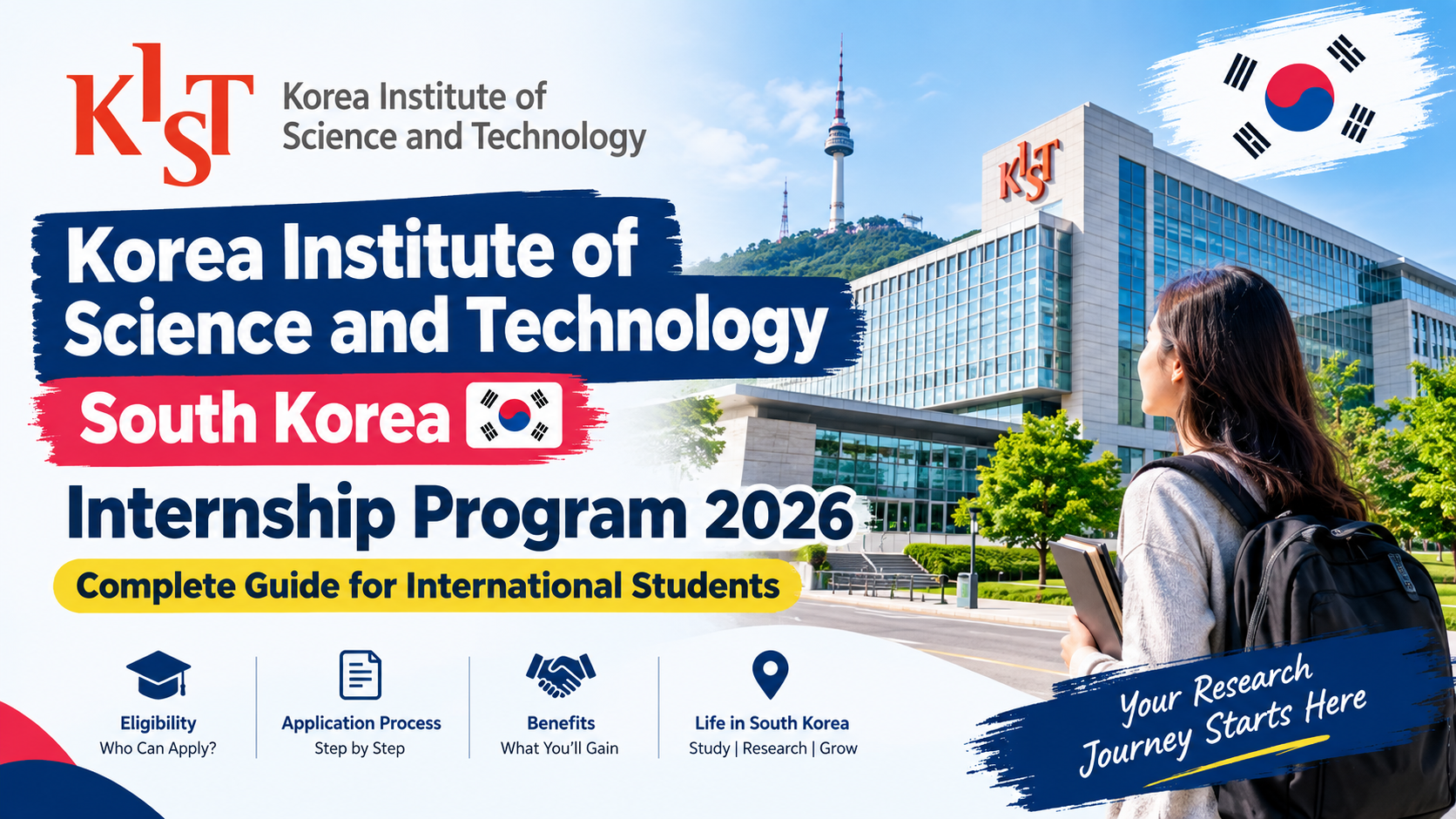
If research in Korea has ever crossed your mind, the Korea Institute of Science and Technology, South Korea | Internship Program for 2026 is one of the more realistic doors into that world. It isn’t a tourist-style exchange or a short campus visit. It’s a genuine placement inside one of Korea’s most respected government-funded research institutes, working alongside scientists who publish in journals most undergraduates only cite.
What makes this opportunity worth your attention isn’t just the prestige of the KIST name. It’s the combination of a monthly stipend, subsidized housing, hands-on lab experience, and a fairly clear pathway toward graduate admission afterward. For students weighing dozens of scholarship and internship options, this one tends to stand out because it’s specific: it exists to prepare you for something bigger, not just to fill a resume line.
Let’s go through what the program actually involves, who qualifies, how the selection works, and the small details that tend to trip applicants up.
What Exactly Is KIST?
The Korea Institute of Science and Technology is South Korea’s first multidisciplinary government-funded research institute, established in the 1960s and still operating as one of the country’s flagship science bodies. It runs research divisions covering everything from brain science and robotics to advanced materials and energy systems. You can browse its current research divisions directly on the official KIST website, which is worth doing before you apply so you can name specific labs or professors in your motivation letter later.
KIST also runs a graduate school arm, commonly referred to as KIST School, operated jointly with the University of Science and Technology (UST). The internship program discussed here feeds directly into that graduate track, which is why it’s sometimes labeled a “KIST School Student Internship Program” rather than a generic internship.
Who This Program Is Actually For
This isn’t an internship aimed at business, finance, or general liberal arts students. It’s built for people already leaning toward a research career, particularly those who might later apply to a Master’s or PhD program at KIST School.
You’re a reasonable fit if:
- You’re currently enrolled as a student and will remain enrolled (or eligible to freeze your semester) throughout the internship
- You have at least a few semesters left before graduation, since the program isn’t designed for graduating seniors
- Your academic background sits in a STEM field aligned with one of KIST’s research divisions
- You’re seriously considering graduate study in Korea, since the internship is explicitly framed as preparation for that step
If none of that applies, that’s fine. There’s no shame in an opportunity not matching your stage. But if you’re a science or engineering student wondering whether a Korean research lab is realistic for you, this is one of the more accessible entry points available.
Eligibility Criteria
Requirements vary slightly by home institution and by intake cycle (spring versus fall), so always cross-check against the current guideline PDF on the official KIST School site, but the recurring conditions look like this:
- Must hold active student status at your home university for the entire internship period
- Applicants who have already graduated are not eligible, since KIST specifically wants “student researchers,” not alumni
- Typically must have fewer than three academic semesters remaining before graduation at the time of application
- Must be physically present on the KIST campus in Seoul for the full internship, which is why most successful applicants arrange a leave of absence from their home university beforehand
- A recommendation letter, academic transcript, CV, and motivation letter are almost always part of the document package
Some partner universities run their own internal screening before forwarding candidates to KIST, so it’s worth checking with your own international office early rather than assuming you can apply directly at the last minute.
Program Structure and Duration
The internship typically runs in two annual cycles:
- Spring intake: roughly March through August
- Fall intake: roughly September through February (with a slightly shorter window for students from certain partner countries, so check your specific track)
During the internship, you’re attached to a research team, contribute to an active project, and in many cases attend a mandatory introductory Korean language course alongside your lab work. This isn’t filler. It’s meant to help you function on campus day to day, and it also happens to be useful if you’re weighing a longer stay in Korea afterward.
Financial Support and What’s Covered
This is where the program earns a lot of its appeal, because it isn’t an unpaid placement.
- A monthly stipend, generally around 1,200,000 KRW for undergraduates and 1,400,000 KRW for Master’s-level applicants (before tax), though exact figures shift slightly year to year
- Dormitory accommodation, typically at a modest monthly cost of roughly 180,000 KRW
- Comprehensive insurance coverage during the internship period
- Access to academic and cultural events organized for international interns
What isn’t covered, and this catches people off guard, is your international airfare. Flights to and from Korea are the applicant’s own responsibility, so factor that into your planning early rather than discovering it after you’ve been selected.
How to Apply, Step by Step
- Check your eligibility window. Confirm you’ll have enough semesters remaining and that your home university has an active partnership or referral process with KIST.
- Identify a research area or advisor. Spend time on the KIST School homepage exploring faculty and majors before you write anything, since a vague motivation letter is one of the fastest ways to get filtered out.
- Prepare your documents. This usually includes an academic transcript, CV, motivation letter, a recommendation letter (sometimes from your dean or vice dean), proof of English proficiency, and in some cases parental consent for departure.
- Submit through the correct channel. Some universities require you to submit through their international office first; others allow direct submission via the KIST School application portal.
- Wait for the review and interview stage, if your program includes one. Not every intake requires a formal interview, but shortlisted candidates are sometimes contacted for a short conversation with the research team.
- Prepare for pre-departure logistics once selected, including visa paperwork, health insurance confirmation, and travel booking.
Tips to Strengthen Your Application
A few things consistently separate accepted applicants from the rest of the pool:
- Name a specific lab or professor. Generic statements like “I’m interested in science” rarely land well. Mention a research division, a recent project, or a publication that genuinely interests you.
- Keep your motivation letter grounded in your own trajectory. Reviewers can tell when a letter has been copy-pasted from another scholarship application.
- Ask your recommender early. A rushed recommendation letter written in two days reads differently than one written with time to reflect.
- Show, don’t just claim, your English readiness. If your proficiency certificate is borderline, a well-written personal statement can partially offset that.
Common Mistakes Applicants Should Avoid
- Applying without checking remaining semester eligibility, which leads to automatic disqualification for many students
- Submitting documents that don’t match KIST’s exact formatting or naming requirements
- Treating the internship as a general travel opportunity rather than a research placement, which shows in weak motivation letters
- Underestimating travel costs, since flights are self-funded and Korean airfare from some regions isn’t cheap
- Missing the application deadline by even a day, since KIST and its partner universities are generally strict about cutoff dates
If You Get an Interview: A Few Practical Tips
Not every applicant faces an interview, but if you do, treat it as a research conversation, not a formal exam.
- Be ready to explain, in your own words, why the specific lab you named fits your background
- Don’t overstate technical skills you can’t actually demonstrate if asked a follow-up question
- It’s fine to say “I don’t know yet, but I’d want to learn that” rather than bluffing your way through a technical question
- Keep your answers focused on research interest and long-term direction rather than reciting your CV back to the panel
Practical Notes for Life at KIST
Once you’re accepted, a little preparation goes a long way:
- Korea’s public transport, particularly Seoul’s subway system, is efficient and worth learning before you arrive rather than after
- Dormitory life is fairly standard shared housing, so packing light and bringing only essentials makes the first week easier
- The mandatory Korean language sessions are genuinely useful for daily errands, not just classroom credit
- Winter and summer intakes mean very different weather, so check the season of your specific cohort before packing
If you’re still comparing this against other funded options in Korea, it’s worth browsing a broader list, such as this overview of top Korean universities offering scholarships for international students, or reading through how to apply for a Korean Government Scholarship if you’d rather pursue a degree-track scholarship instead of an internship. Students specifically interested in tech-focused placements might also want to look at the GCF IT Internship in South Korea as a parallel option.
Frequently Asked Questions
1. Is the KIST Internship Program paid?
Yes. Selected interns receive a monthly stipend, along with subsidized dormitory accommodation and insurance coverage. International airfare, however, is not covered.
2. Can final-year students apply?
Generally no. Most intakes require applicants to have more than a set number of semesters remaining before graduation, since the program is designed to feed into graduate study, not act as a farewell internship.
3. Do I need to already be admitted to a KIST graduate program to apply?
No. The internship is a preparatory step. It’s meant to happen before you formally apply to KIST School’s Master’s or PhD programs, not after.
4. Is Korean language proficiency required?
Not typically as an entry requirement, but a mandatory introductory Korean language course is usually part of the program once you’re accepted.
5. How competitive is the selection process?
It varies by intake and by how many partner universities are sending candidates that cycle, but because slots are limited and tied to specific labs, a focused, well-researched application matters more than a generic one.
6. What happens if I can’t attend the full internship period?
Physical presence on campus for the full duration is usually a firm requirement, so partial attendance generally isn’t an option. Most successful applicants arrange a formal leave of absence from their home university in advance.
7. Where can I find the official application portal and guidelines?
Always apply through the official KIST School website or your home university’s international office. Avoid third-party sites claiming to process applications on KIST’s behalf.
The Korea Institute of Science and Technology, South Korea | Internship Program rewards applicants who treat it as a research opportunity rather than a checkbox scholarship. If you go in with a clear sense of which lab you want to join and why, your application will read very differently from the majority of the pool, and that difference tends to be exactly what gets noticed.
Share this content:

